
It was the best of times, it was the worst of times…”
Charles Dickens could have been describing today’s stock market.
The S&P 500 is pressing into new highs, suggesting a healthy bull market. Yet beneath that headline, smaller companies are telling a considerably different story.
How can both be true?
The answer begins with understanding what is actually driving the indexes.
The S&P 500 — The Best of Times
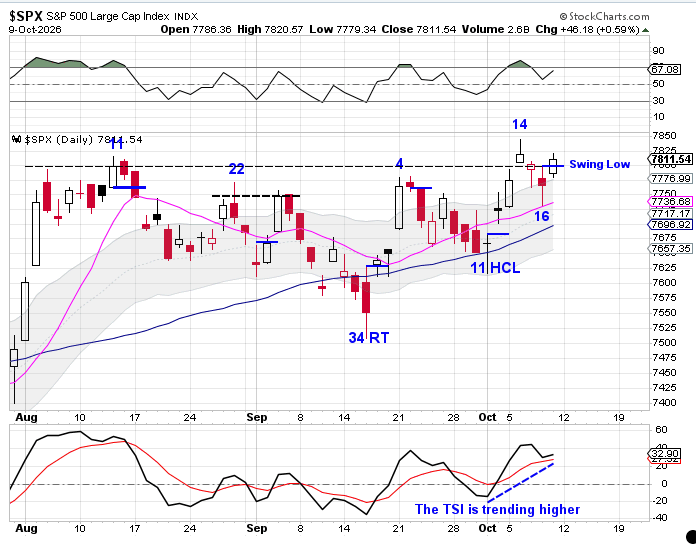
The S&P 500 continues to display bullish Daily-cycle behavior. Its latest swing low formed near the rising 10-day moving average, and Friday’s close above 7,800 reinforces the bullish outlook.
The index remains in a Daily uptrend, with price action supporting continued upside.
But the S&P 500 does not represent 500 equally influential companies. It is weighted by market capitalization, meaning the largest companies have the greatest influence on its performance.
That distinction matters.
The Russell 2000 — The Worst of Times?
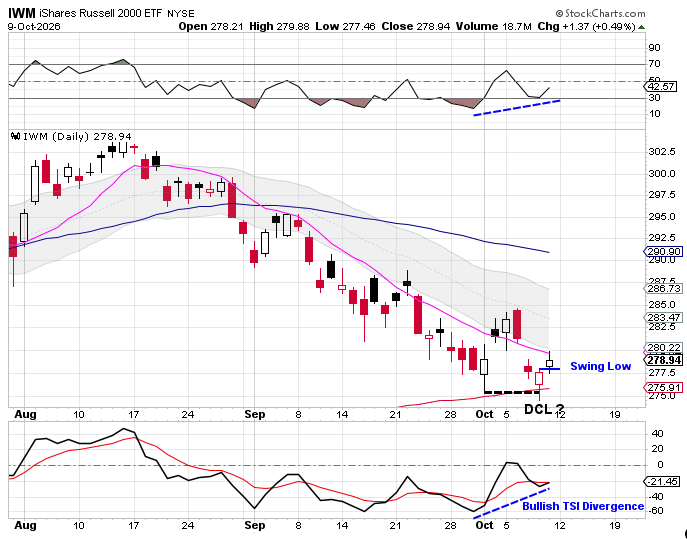
The Russell 2000 tells a different story.
While the S&P 500 pushes higher, small-cap stocks continue struggling to establish a convincing reversal. Price remains challenged by declining moving averages, reflecting considerably weaker technical conditions.
Smaller companies can be more sensitive to borrowing costs and tighter financial conditions. Higher interest rates may therefore create greater headwinds for these businesses than for large, cash-rich corporations.
That is one possible explanation for the divergence, although the charts themselves cannot establish its cause.
What they do establish is that these two segments of the market are behaving very differently.
Enter the Magnificent Seven
Apple, Microsoft, Nvidia, Amazon, Alphabet, Meta, and Tesla—the Magnificent Seven—account for roughly one-third of the S&P 500’s market capitalization.
Their enormous weighting gives them substantial influence over the direction of the index.
And their recent price behavior is particularly revealing.
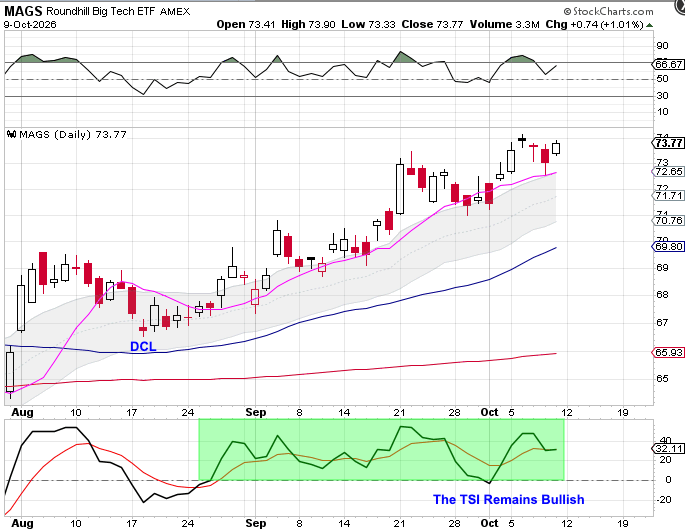
The Roundhill Magnificent Seven ETF (MAGS), which provides equal-weight exposure to these companies, recently formed a Daily swing low above the upper Daily Cycle Band.
That is an exceptionally strong technical development.
Rather than experiencing the deeper correction often associated with a Daily-cycle decline, this group has demonstrated sufficient strength to maintain its position above the upper band.
MAGS does not measure the Magnificent Seven’s exact contribution to the S&P 500. But it provides compelling visual evidence of the strength within this influential group.
One Market, Two Experiences
For an investor concentrated in the largest technology-oriented companies, this may feel like the best of times.
For an investor holding smaller companies struggling against higher financing costs and weaker technical conditions, the experience may be considerably different.
Both investors are participating in the same stock market.
But they are not necessarily experiencing the same market.
Cycle Alignment
The S&P 500 remains in a bullish Daily trend, supported by its recent swing low and breakout above resistance.
The Magnificent Seven are demonstrating exceptional Daily-cycle strength.
The Russell 2000, meanwhile, has yet to establish comparable bullish price behavior.
The distinction is not a prediction that one group must catch up with the other. It is an observation that market leadership remains uneven.
And that brings us back to Dickens.
It was the best of times, it was the worst of times.
Sometimes, understanding the stock market begins with recognizing that both can be true.


Leave a Reply